
Descrizione
Memory is our future, this is the title we gave to the projects to celebrate the Bicentenary of the Egyptian Museum; the same goes for the publication in which Andrea Goldstein recalls the distant events of the 1956 Winter Games in Cortina. Passing through Turin 2006, up to Milan Cortina 2026, this is a beautiful journey to celebrate Italy’s Olympic history.
Evelina Christillin
First Deputy President of the Torino 2006 Organizing Committee; President of the Museo Egizio
Andrea Goldstein completes his trilogy on the political economy of global sports with this history of the 1956 Winter Olympics. He is unrivalled in the ability to synthesize the many complex issues at stake – diplomatic and economic, social and political, economic and environmental, local and global – to offer the reader a fine example of the kind of reasoned judgement that is as rare as it is necessary in our democracies.
Patrick Clastres
Professor of International Sport History and Director of the Centre d’études olympiques & de la globalisation du sport, University of Lausanne
Andrea Goldstein has contributed so much to our understanding of sports history. Here he tackles an almost forgotten winter Olympics, and tells a story that reveals so much about both postwar Italy and the Cold War more broadly – all written in good clear prose. He understands that sport matters in itself, but is also always more than sport.
Simon Kuper
Columnist, Financial Times; co-author of Soccernomics
Andrea Goldstein, an economist with a long career in various international organizations, recently published Il potere del pallone. Economia e politica del calcio globale (il Mulino 2022; Spanish edition Rialp 2023) and Quando l’importante è vincere. Politica ed economia delle Olimpiadi (il Mulino 2024).
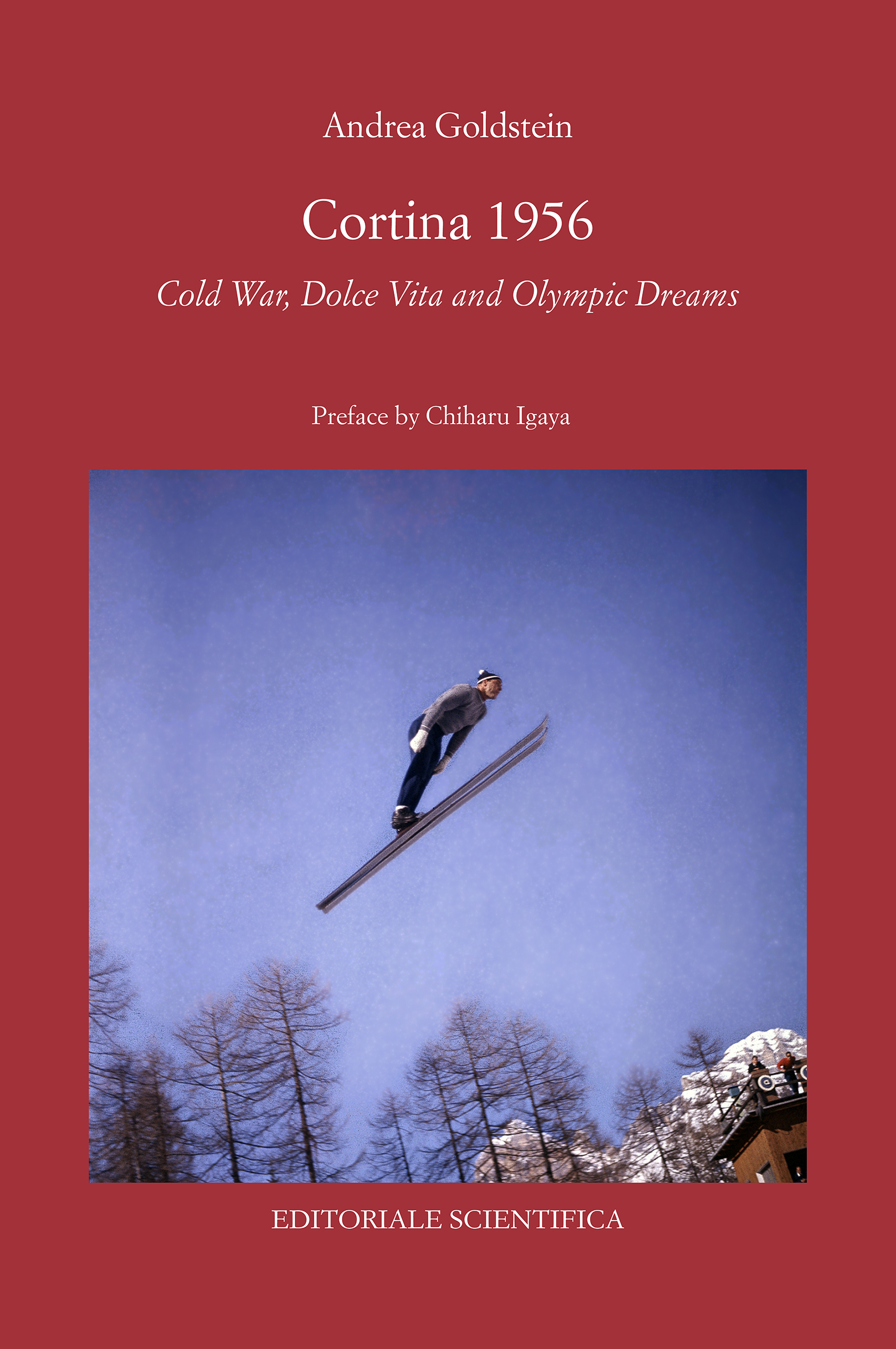
Tenley Albright – who had started skating as a child to recover from polio and won the gold medal despite a serious injury just days before the competition – and Prince Bertil of Sweden – who made sure slope salters and sled drivers were invited to his gala reception. Toni Sailer – who entered history by winning all the Alpine ski races by monstrous margins – and Sophia Loren – who arrived with the few things necessary for a couple of days crammed into seven fiery red trunks. Eugenio Monti – who on his home bobsleigh track collected the first laurels of a career that ended 12 years later, at the age of 40, with two Olympic gold medals – and Lester Rodney — who in the middle of the Cold War covered the Soviet triumphs for the daily paper of the American Communist Party. These are but some of the protagonists of the first Olympics organized in Italy, in the midst of an economic boom, just 11 years after the end of the Second World War. But they were also the first to be broadcast live on television, the first in which a woman read the athletes’ oath, the first in which the two Germanys competed under the same flag, the first with a strong business involvement. The story of Cortina 1956 ranges from sports to economics, from politics to social life, in an ideal journey that leads from those unforgettable Games to Milan Cortina 2026.